
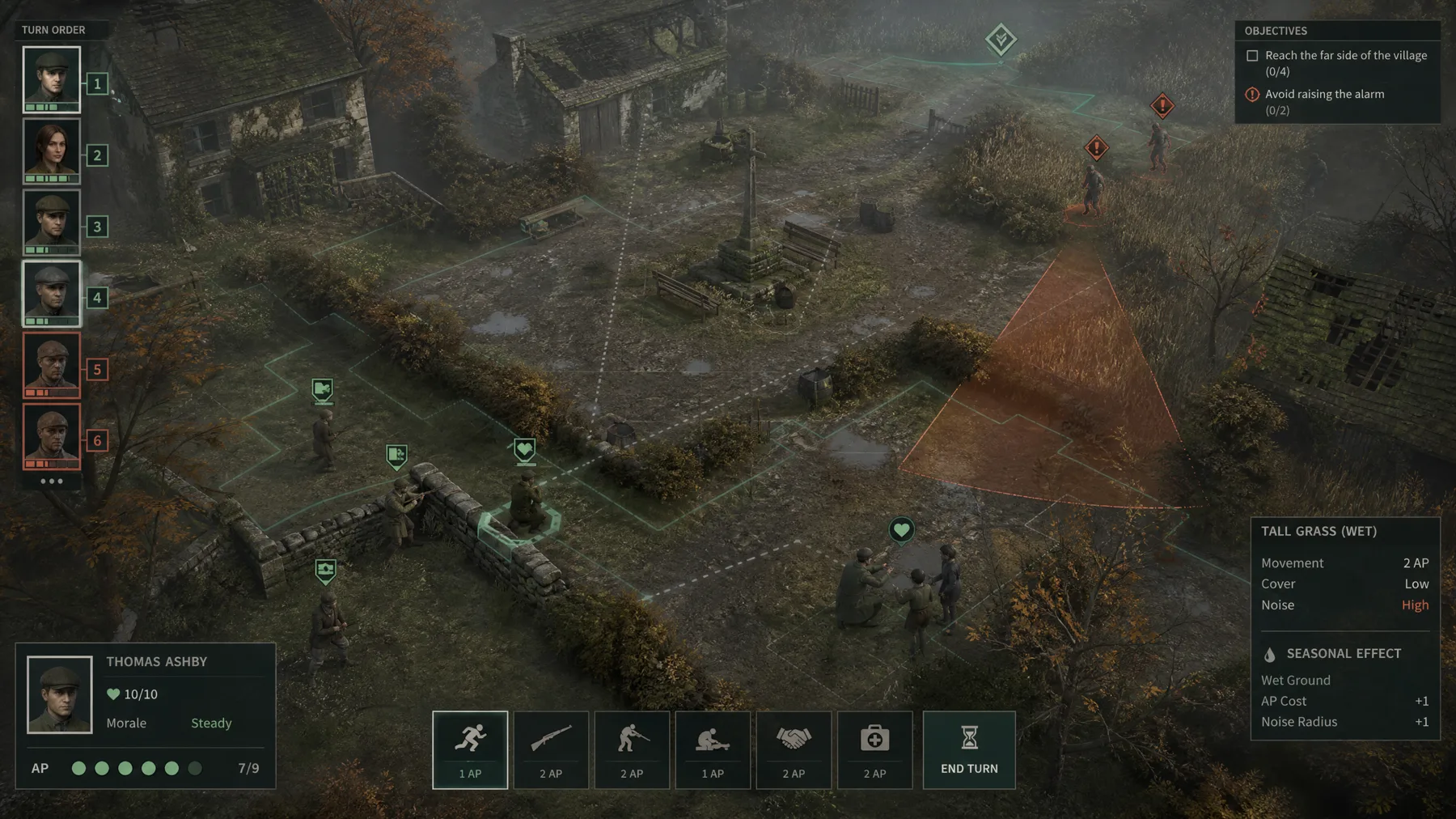
There is a peculiar tension in the English countryside, a quiet hostility that The Silent Green captures with remarkable precision. This turn-based tactical outing, available across PC, PlayStation 5, and Xbox Series consoles, swaps the exhausted science-fiction corridors of its genre contemporaries for the deceptively idyllic settings of rural hamlets and overgrown village greens. It is a game where a neatly trimmed hedgerow is not merely picturesque landscaping, but a vital lifeline against an encroaching threat. By anchoring its complex systems in such a grounded environment, the developer has crafted a strategy experience that feels deeply rooted in the traditions of the genre while offering a refreshing change of scenery.
At its core, The Silent Green is an intricate dance of action points and positioning, governed by a ruthlessly unforgiving turn order. You command a four-person unit, each member possessing distinct specialisations, as they navigate the pastoral battlegrounds. The interface is clean and communicative; the HUD elegantly displays the action economy, sight cones, and the ever-shifting turn queue without cluttering the screen. However, the true masterstroke of the game's mechanical design lies in its morale system. In many tactical games, health is the only metric that matters. Here, morale is a volatile resource dictating the flow of every encounter. Pinned down behind a stone wall with enemy fire whittling away at their cover, your units will suffer severe morale degradation. A panicked soldier might squander action points, break from cover, or refuse to fire altogether. Conversely, executing a well-coordinated flanking manoeuvre or securing a commanding vantage point will bolster their resolve, granting crucial buffs to accuracy and movement range. This psychological layer transforms every skirmish into a desperate struggle to maintain the mental fortitude of your squad.
The Tactical Hedgerow
The environment itself is a dynamic participant in these rural skirmishes, primarily through the implementation of seasonal terrain. The Silent Green does not merely use seasons as a visual dressing; they fundamentally alter the tactical landscape. A summer engagement might offer thick foliage that obscures sight cones, allowing for stealthy approaches but severely limiting your own situational awareness. Return to that same village green in the dead of winter, and the bare branches offer no concealment, turning the open ground into a lethal killing zone. Spring brings treacherous mud that drains action points and slows movement to a crawl, while autumn litters the battlefield with dry leaves that crunch underfoot, betraying the position of flanking units. This seasonal rotation forces a constant re-evaluation of strategy, ensuring that you can never rely on a single, static approach to combat.
Cover, naturally, is paramount. The hedgerows that crisscross the maps provide excellent concealment and moderate physical protection, but they are entirely destructible. Sustained fire will shred the foliage, exposing anyone sheltering behind it. This impermanence of cover forces a highly mobile style of play. You are constantly bounding from a dry stone wall to a tractor, from a tractor to a sturdy oak tree, always aware that your current sanctuary could be obliterated in the next turn. The sight cones, projected clearly on the terrain, become vital tools for navigating this shifting battlefield, allowing you to plot routes that keep your unit out of the enemy's direct line of sight.
Protecting the Innocent
Complicating these tactical considerations is the frequent presence of civilians. The Silent Green tasks you with protecting the inhabitants of these rural communities, adding a layer of fraught responsibility to the proceedings. Civilians are unpredictable, often panicking and fleeing directly into the line of fire. Your unit must not only neutralise the hostile threat but also manage the movement of these non-combatants, sometimes expending valuable action points to direct them towards safety or physically shield them from harm. Failing to protect civilians carries heavy penalties, both in terms of mission scoring and the overarching campaign morale. It is a demanding system that forces agonising choices between securing a tactical advantage and saving an innocent life.
Campaign and Progression
The campaign structure eschews the linear progression of traditional narratives in favour of a more dynamic, reactive map. You are tasked with defending a sprawling county, responding to incursions as they arise across various hamlets and farmsteads. Time is a critical resource; choosing to respond to a distress call in one village might mean leaving another to fend for itself, with permanent consequences for the region's stability. Between missions, you manage your unit's equipment, heal their physical and psychological wounds, and research new tactics based on the intelligence gathered in the field. The progression system is deep and satisfying, allowing you to tailor your squad to your preferred playstyle.
"The psychological layer transforms every skirmish into a desperate struggle to maintain the mental fortitude of your squad."
However, the campaign can occasionally feel slightly repetitive in its middle act. While the seasonal changes and varied terrain do much to keep the encounters fresh, the pool of objective types is somewhat limited. You will find yourself conducting similar extraction or defence missions more often than one might like, which can slightly dull the impact of the otherwise excellent tactical gameplay.
Performance, Controls, and Accessibility
Technically, The Silent Green performs admirably across all platforms. On the PlayStation 5 and Xbox Series X, the game maintains a rock-solid framerate, ensuring a smooth and responsive experience. The visual fidelity is impressive, capturing the melancholic beauty of the British countryside with detailed textures and evocative lighting. The PC version is equally robust, offering a wealth of graphical options to tailor the experience to a wide range of hardware configurations.
Translating complex tactical controls to a gamepad is a perennial challenge for the genre, but the developer has managed it with considerable aplomb. The console controls are intuitive, utilising radial menus and smart snapping to make navigating the battlefield and selecting actions a seamless process. While the mouse and keyboard remain the optimal way to play, offering the precision and speed inherent to the platform, console players will not feel hampered by the interface.
Crucially, the game boasts a comprehensive suite of accessibility and difficulty options. Recognising that the unforgiving nature of tactical combat can be alienating, the developer has included granular sliders that allow players to adjust everything from enemy health and damage output to the severity of the morale system. Furthermore, there are robust options for colour blindness, UI scaling, and subtitle customisation, ensuring that the game is welcoming to as broad an audience as possible.
The Final Verdict
The Silent Green is a triumph of atmospheric design and mechanical depth. By shifting the focus from physical health to psychological resilience, it breathes new life into the turn-based tactics genre. The seasonal terrain and the constant, stressful need to protect civilians ensure that every engagement is a fraught, unpredictable affair. While the campaign structure can occasionally feel a little rote, the moment-to-moment gameplay is consistently thrilling, demanding careful planning and flawless execution. It is a game that understands the quiet menace of a seemingly peaceful landscape, turning every village green and hedgerow into a potential killing field. For fans of tactical strategy, this is an essential deployment.
- Score: 8.7 / 10
- Verdict: A deeply engaging and atmospheric tactical experience that rewards careful planning and psychological management.
| Criterion | Grade |
|---|---|
| Tactical Depth | Excellent |
| Atmosphere | Outstanding |
| Campaign Structure | Good |
| Performance | Excellent |