
Violet Static impressions: Mix the signal before it finds you
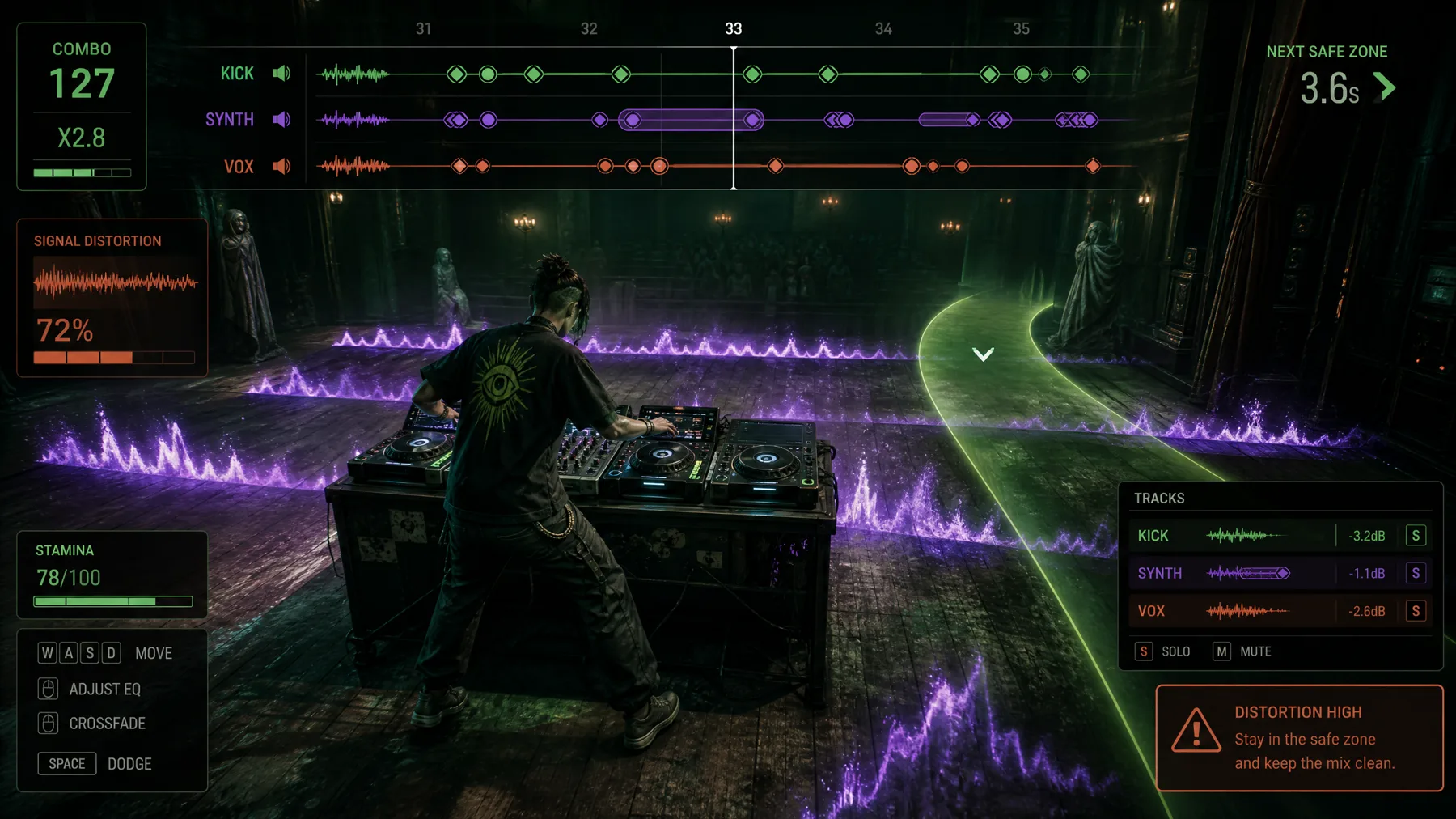
There is a specific, creeping dread that comes from realising the beat you are nodding along to is actively hunting you. In Violet Static, the latest rhythm horror hybrid to grace PC, PlayStation 5, and Xbox Series consoles, the music is both your primary weapon and your most persistent adversary. As a playable DJ navigating the cavernous expanse of an abandoned theatre stage, your task is not merely to perform, but to survive. The premise is brilliantly unsettling: mix the signal before it finds you, balancing the demands of a complex audio landscape with the immediate physical threat of the soundwaves themselves.
At its core, Violet Static demands a constant, exhausting synchronisation of mind and fingers. The live mixing mechanics require you to juggle multiple track layers—percussion, bass, melody, and the ever-present, corrupting 'distortion'—while physically moving your avatar across the stage. This is not a static rhythm game where you simply tap buttons in time to a descending chart; it is a frantic, spatial dance. You must physically dodge the manifestations of the music you are creating, turning the traditional rhythm game paradigm on its head. The theatre stage serves as a brilliant arena for this, its grand, decaying architecture providing a stark contrast to the neon-drenched, pulsating threats that emerge from the darkness.
Live Mixing and Movement
The interplay between live mixing and movement is where the game truly excels. The HUD is a masterclass in information design, conveying a staggering amount of data without overwhelming the player. A central beat lane dictates the core rhythm, but your attention is constantly pulled to the peripheral indicators: your current combo, the rising level of distortion, the status of your track layers, your stamina bar, and the ever-shifting safe zones. Moving your DJ across the stage consumes stamina, meaning you cannot simply run indiscriminately to avoid danger. Every movement must be calculated, timed to the beat, and executed with precision. When you successfully mix a new layer into the track whilst simultaneously sliding into a fleeting safe zone, the resulting rush of adrenaline is palpable.
However, the true genius of Violet Static lies in its signal hazards. As the tracks grow more complex, the violet waveforms that pulse from the speakers cease to be mere visual flair and solidify into lethal obstacles. These waveforms sweep across the stage in intricate patterns, forcing you to read the rhythm not just from the beat lane, but from the environment itself. Rhythm readability is paramount here, and for the most part, the developers have struck a delicate balance.
Rhythm Readability and Signal Hazards
The violet waveforms are not just obstacles; they are physical manifestations of the music's distortion. If you allow the distortion level to rise too high—by missing beats, failing to mix layers correctly, or spending too much time outside the safe zones—the waveforms become more aggressive, their patterns more erratic and difficult to predict. This creates a terrifying feedback loop where poor performance directly increases the immediate physical danger to your character. It is a punishing system, but an immensely satisfying one when mastered. The sense of flow achieved when you are perfectly in sync with the music, weaving through a labyrinth of deadly violet light, is unparalleled in the genre.
Chapter pacing is another area where Violet Static shines. The game is structured into distinct sets, each introducing new mechanics, track layers, and hazard patterns. The difficulty curve is steep but fair, with each chapter building upon the lessons of the last. The early stages ease you into the mechanics of movement and basic mixing, while the later chapters demand absolute mastery of the game's complex systems.
Controls and Accessibility
Given the complexity of the mechanics, the controls are surprisingly intuitive, though they do require a significant period of adjustment. On a controller, the analogue sticks govern movement and camera control, whilst the triggers and bumpers handle the mixing of track layers. The face buttons are reserved for interacting with the beat lane. It is a dense control scheme, but one that quickly becomes second nature. On PC, the keyboard and mouse setup is equally viable, offering perhaps a slight edge in terms of raw precision, though the analogue movement of a controller feels more natural when navigating the stage.
From a technical standpoint, the current build performs admirably across all platforms. On the PlayStation 5 and Xbox Series X, the game maintains a rock-solid sixty frames per second, a crucial requirement for a game where split-second timing is everything. The visual presentation is striking, with the stark contrast between the decaying theatre and the vibrant, neon violet waveforms creating a truly unique aesthetic. The audio design, naturally, is phenomenal.
Accessibility is often a sticking point for rhythm games, but Violet Static makes a commendable effort to be inclusive. The game offers a robust suite of options, allowing players to adjust the speed of the beat lane, the intensity of the visual effects, and the leniency of the timing windows. There are also options to disable certain types of hazards or automate specific mixing tasks, ensuring that players of all skill levels can experience the game's unique blend of rhythm and horror.
"The interplay between live mixing and movement is where the game truly excels, creating a terrifying feedback loop where poor performance directly increases the immediate physical danger to your character."
Current Build Performance
We tested the game primarily on the PlayStation 5, but also spent considerable time with the PC and Xbox Series versions. The performance was uniformly excellent. Load times are practically non-existent on the current-generation consoles, allowing you to jump straight back into the action after a failure. The haptic feedback on the DualSense controller is particularly noteworthy, providing subtle, tactile cues that correspond to the beat and the proximity of hazards. It adds an extra layer of immersion to an already engrossing experience.
There are a few minor blemishes, however. Occasionally, the collision detection on the violet waveforms can feel slightly unforgiving, leading to frustrating deaths that feel outside of the player's control. Additionally, while the soundtrack is excellent, a slightly wider variety of genres would have been welcome. The relentless focus on heavy, industrial electronic music fits the aesthetic perfectly, but can become somewhat exhausting over extended play sessions.
Verdict
Despite these minor grievances, Violet Static is a triumph of game design. It successfully merges two disparate genres into a cohesive, terrifying, and immensely satisfying whole. The mechanics are deep and rewarding, the presentation is stellar, and the core gameplay loop is incredibly addictive. It is a game that demands your full attention and punishes your mistakes, but rewards your successes with a sense of flow and accomplishment that few other titles can match. It is a bold, innovative step forward for the rhythm genre, and a must-play for anyone looking for a unique and challenging experience.
| Criterion | Grade |
|---|---|
| Live Mixing Mechanics | Excellent |
| Signal Hazards | Brutal |
| Rhythm Readability | Strong |
| Chapter Pacing | Balanced |
| Accessibility Options | Comprehensive |
Score: 8.8 / 10
Violet Static is a masterclass in tension and rhythm. By forcing the player to physically navigate the hazards their music creates, it elevates the traditional rhythm game into a frantic, terrifying fight for survival. Mix the signal, watch your stamina, and whatever you do, do not let the violet waveforms catch you off guard.